Why Term 3 Is the Most Important Semester for PSLE Students
- Seashell Academy
- Jul 1
- 4 min read

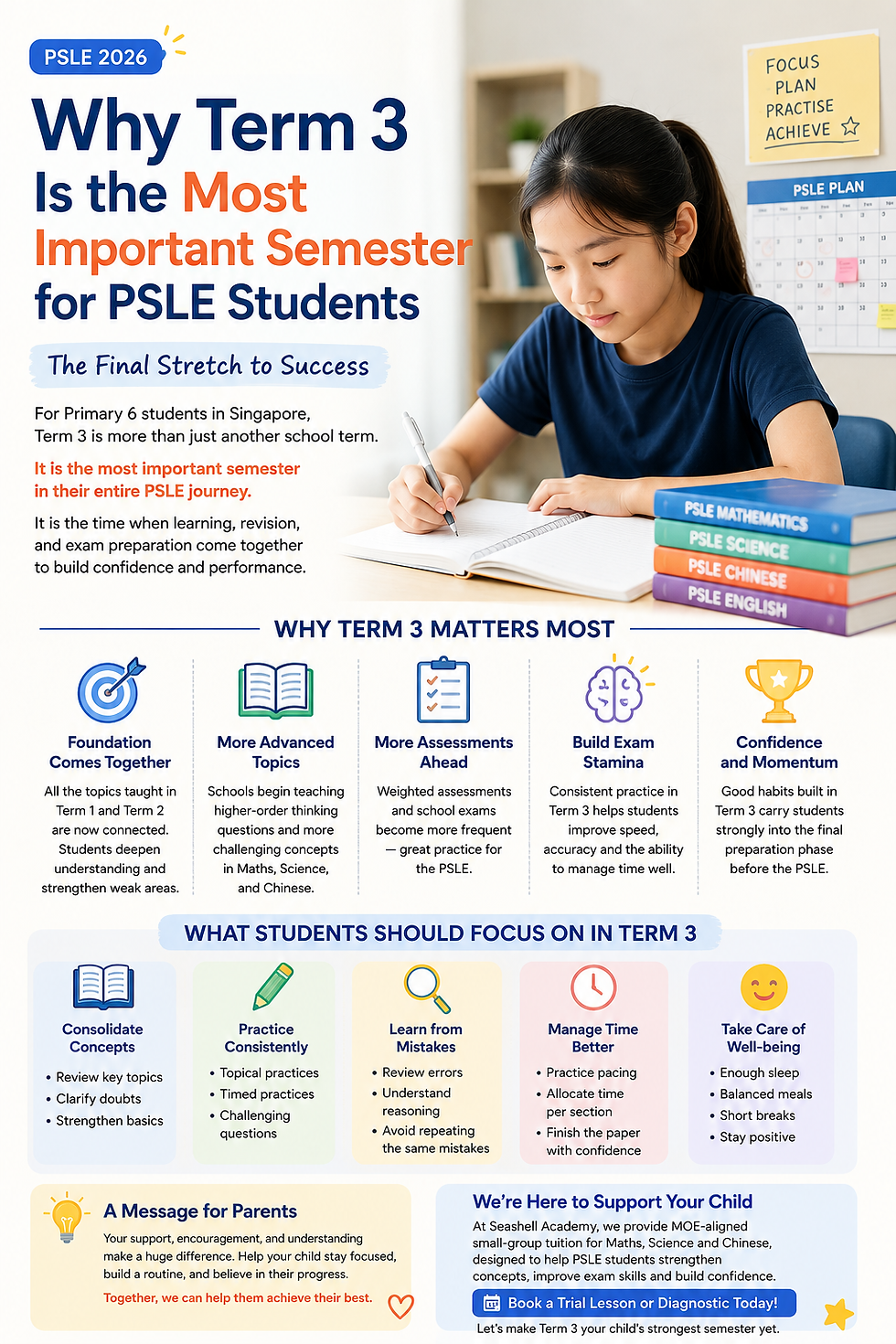
For many Primary 6 families in Singapore, the PSLE can feel overwhelming.
After months of learning new topics in the first half of the year, many parents assume there is still plenty of time before the examination.
The truth is quite the opposite.
Term 3 is often the most important semester of the entire PSLE journey.
It is the period where knowledge, exam skills, confidence, and consistency all come together.
Students who use Term 3 effectively often enter the final revision period with confidence.
Students who fall behind during Term 3 may find it difficult to catch up before the PSLE begins.
At Seashell Academy, we always encourage parents to view Term 3 not as "just another school term," but as the turning point towards PSLE success.
Why Is Term 3 So Important?
Unlike the earlier school terms, Term 3 is no longer about simply learning new topics.
Instead, it focuses on helping students connect everything they have learnt throughout Primary 6.
This is when schools begin to place greater emphasis on:
Full-paper practice
Exam strategies
Time management
Higher-order thinking questions
Application-based problem solving
Error correction
Students are expected to think deeper, solve faster, and apply concepts across multiple topics.
This shift often surprises many students.
1. Students Start Seeing the "Big Picture"
By Term 3, almost every major syllabus topic has already been taught.
Instead of learning isolated chapters, students begin to understand how different concepts are connected.
For example:
Mathematics
Students learn to combine:
Fractions
Ratio
Percentage
Speed
Algebra
Geometry
within a single problem-solving question.
Science
Students are expected to apply knowledge from:
Systems
Energy
Cycles
Forces
Plant and Animal Processes
to answer complex open-ended questions.
Chinese
Students begin integrating:
Vocabulary
Comprehension skills
Oral communication
Composition techniques
rather than practising each component separately.
This stage develops deeper conceptual understanding instead of memorisation.
2. Schools Increase the Difficulty Level
Another reason Term 3 is so important is that school assessments become significantly more challenging.
Questions become:
longer
less direct
more application-based
more similar to actual PSLE papers
Students who previously scored well may suddenly feel that the papers are "much harder."
This is completely normal.
Teachers are intentionally preparing students for the standard of the national examination.
3. Full PSLE Practice Begins
During Term 3, students usually move beyond topical worksheets.
Instead, they begin practising:
Full Mathematics papers
Full Chinese papers
Full Science papers
Timed examinations
This helps students develop critical exam skills such as:
managing time
checking answers
maintaining concentration
working under pressure
These are skills that cannot be developed through content learning alone.
4. Small Weaknesses Become Bigger Problems
Many students still have minor learning gaps from earlier in the year.
Examples include:
careless mistakes
weak fractions
difficulty with Science explanation questions
limited Chinese vocabulary
poor time management
During Term 3, these weaknesses become much more obvious.
The good news?
There is still enough time to correct them—provided students identify them early and work consistently.
Waiting until August or September often makes improvement much more difficult.
5. Confidence Is Built During This Semester
Confidence is one of the biggest predictors of PSLE performance.
Students who experience steady progress during Term 3 often:
become more motivated
enjoy learning more
stay calmer during examinations
perform more consistently
On the other hand, repeated struggles without proper support may reduce confidence and increase exam anxiety.
Confidence is not built overnight.
It is built through consistent practice, gradual improvement, and positive learning experiences.
What Should Primary 6 Students Focus On During Term 3?
Rather than simply doing more worksheets, students should focus on learning smarter.
Here are five priorities:
1. Consolidate Key Concepts
Review topics regularly instead of waiting until the final revision period.
Build strong understanding before attempting difficult questions.
2. Practise Consistently
Daily practice is usually more effective than long study sessions once a week.
Consistency helps students retain concepts and build speed.
3. Learn From Mistakes
Incorrect answers are valuable learning opportunities.
Instead of simply checking the correct answer, students should ask:
Why did I get this wrong?
Which concept did I misunderstand?
How can I avoid making the same mistake again?
4. Improve Time Management
Many capable students lose marks because they cannot finish the paper.
Timed practices help students learn to:
pace themselves
prioritise questions
leave sufficient time for checking
5. Maintain Healthy Study Habits
Good academic performance also depends on healthy routines.
Students should aim for:
sufficient sleep
regular exercise
balanced meals
limited screen time
scheduled study routines
A healthy body supports better concentration and memory.
How Parents Can Support Their Child During Term 3
Parents play a significant role during this critical semester.
Simple actions can make a meaningful difference.
Encourage consistency instead of perfection.
Celebrate improvement rather than focusing only on marks.
Build a predictable study routine.
Regular revision is more effective than last-minute cramming.
Communicate positively.
Avoid comparing your child with classmates or siblings.
Instead, focus on personal progress.
Help identify learning gaps early.
If your child repeatedly struggles with the same concepts, additional support during Term 3 can prevent these gaps from growing larger.
How Seashell Academy Supports PSLE Students
At Seashell Academy Singapore, our Primary 6 programme is designed specifically around the demands of Term 3.
Our MOE-aligned lessons help students:
strengthen conceptual understanding
improve higher-order thinking
master exam strategies
build confidence under timed conditions
reduce careless mistakes
prepare effectively for PSLE
Through small-group classes, personalised guidance, and structured revision, we help students maximise this important stage of their PSLE journey.
Because success in the PSLE is rarely determined during the final few weeks.
It is built steadily throughout Term 3.
For Primary 6 students, Term 3 is the bridge between learning and examination success.
It is when students consolidate everything they have learnt, strengthen weak areas, and develop the confidence needed for the PSLE.
Families who take advantage of this semester often find that the final revision period becomes far less stressful.
Rather than asking, "Is it too early to prepare?"
A better question is:
"How can we make the most of Term 3?"
The answer may make all the difference when PSLE arrives.
Looking for PSLE Tuition in Singapore?
At Seashell Academy, we help Primary 6 students strengthen Mathematics, Science, and Chinese through structured, MOE-aligned lessons, targeted revision, and small-group learning.
Book a trial lesson or a PSLE diagnostic assessment today and help your child build confidence, close learning gaps, and make the most of this crucial Term 3 before the PSLE.


Comments