The Power of Hands-On Science Experiments at Home: Boosting Curiosity in a Digital Age

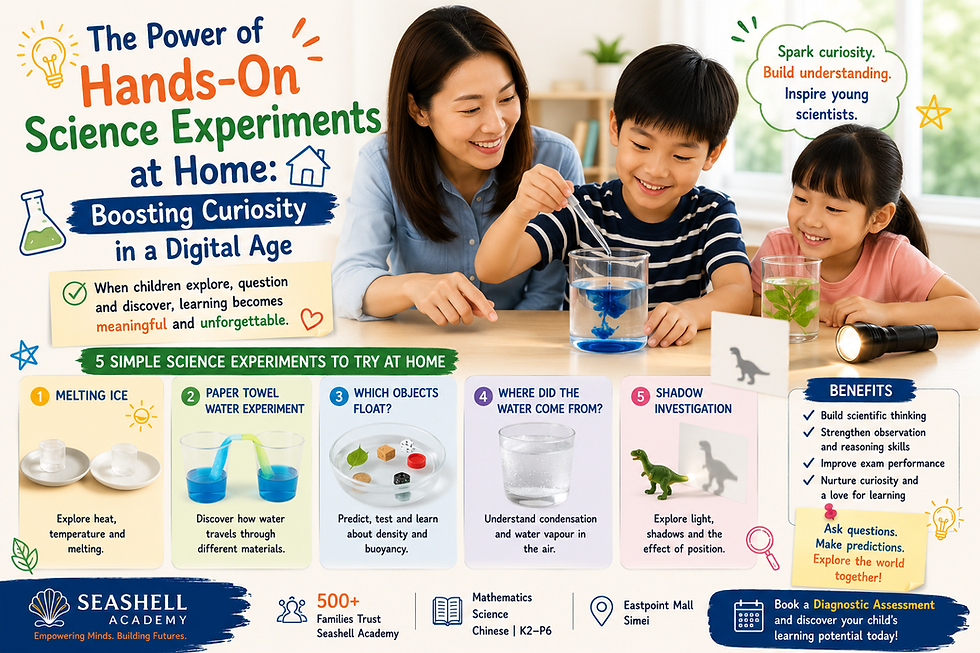
In a world where children can find almost any answer with a quick search, watch an experiment on YouTube or ask AI to explain a Science concept in seconds, learning has never been more accessible.
But there is one thing a screen cannot fully replace:
The experience of discovering something for yourself.
Why does a paper towel absorb water?
Why does condensation form on a cold glass?
Why do some objects float while others sink?
Why does a shadow change when we move a light source?
For primary school children, these simple moments of curiosity can become powerful Science lessons.
At Seashell Academy, we believe Science should not only be something children read about.
It should be something they observe, question, test and explain.
And parents don't need a laboratory to make this happen.
Some of the most meaningful Science experiments can begin right at home.
Why Hands-On Science Matters More in a Digital Age
Today's children grow up surrounded by technology.
They have access to videos, educational apps, online lessons, digital worksheets and AI-powered learning tools.
Technology can be extremely useful for education.
But Science is fundamentally about understanding the world around us.
A child can watch ten videos explaining evaporation.
But placing a wet cloth under the sun and observing what happens creates a very different learning experience.
The child begins asking:
Where did the water go?
Would it dry faster indoors or outdoors?
Would a larger cloth dry faster?
Does temperature make a difference?
Suddenly, Science isn't a paragraph in a textbook.
It becomes a question waiting to be investigated.
From Memorising Science to Thinking Like a Scientist
One of the biggest challenges we see in Primary Science is that students sometimes become very good at remembering information without fully understanding how to apply it.
They may memorise:
“Evaporation is the process by which water changes from a liquid to a gas.”
But when presented with an unfamiliar PSLE Science question, they may struggle to explain why one condition causes water to evaporate faster than another.
Hands-on experiments help bridge this gap.
When children conduct experiments themselves, they naturally practise important scientific process skills such as:
observing
comparing
predicting
classifying
measuring
identifying variables
interpreting results
drawing conclusions
explaining cause and effect
These are also important skills students need when tackling Primary Science and PSLE Science questions.
5 Simple Science Experiments Parents Can Try at Home
You don't need expensive Science kits.
Many useful experiments can be done with ordinary household items.
1. The Melting Ice Experiment
You Need
2 ice cubes
2 plates
different locations around the house
Place one ice cube somewhere warm and another somewhere cooler.
Ask your child:
Which ice cube do you think will melt first? Why?
Then observe what happens.
Science Concepts
This can introduce discussions about:
Heat • Temperature • Melting • Heat Transfer
The important part isn't simply watching the ice melt.
Ask your child to predict first and explain afterwards.
2. The Paper Towel Water Experiment
Place one end of a folded paper towel into a cup of coloured water and allow the other end to hang into another cup.
Over time, children can observe the water travelling through the material.
Ask:
What do you notice?
What do you think will happen next?
Would every material behave the same way?
You can then test tissue paper, cloth or other materials.
Science Skills
This activity encourages:
Observation • Comparison • Prediction • Material Properties
3. Which Objects Float?
Fill a container with water and collect several household objects.
For example:
plastic spoon
coin
leaf
small toy
bottle cap
eraser
Before placing each object into the water, ask your child:
“Do you think this will float or sink?”
More importantly:
“Why do you think so?”
Create two groups:
Prediction → Actual Result
Children quickly discover that their assumptions are not always correct.
And that is exactly where scientific thinking begins.
4. Where Did the Water Come From?
Take a cold drink from the refrigerator and leave it on the table.
After several minutes, water droplets will begin appearing on the outside.
Ask your child:
“Where did this water come from?”
Many children initially believe the water leaked through the glass.
This creates an excellent opportunity to discuss:
Water Vapour → Heat Loss → Condensation → Water Droplets
This simple household observation connects directly with concepts students encounter in Primary Science.
5. Build a Simple Shadow Investigation
All you need is:
a torch
a small object
a wall
Move the torch closer to and further away from the object.
Ask your child to observe how the shadow changes.
Try moving the object instead.
Ask:
What changed?
What stayed the same?
What do you think caused the shadow to become larger?
Science Concepts
Children can explore:
Light • Shadows • Position • Observation • Cause and Effect
The Most Important Part Isn't the Experiment
Parents sometimes think Science activities need to be impressive.
They don't.
You don't need explosions, complicated equipment or elaborate Science kits.
The most valuable part often happens after the experiment.
It is the conversation.
Instead of immediately explaining the answer, try asking:
What did you notice?
What surprised you?
Why do you think that happened?
What would happen if we changed this?
How could we test your idea?
These questions encourage children to think rather than simply wait for an answer.
Try the P-O-E Method at Home
Parents can use a very simple framework when conducting Science activities:
P — Predict
What do you think will happen?
↓
O — Observe
What actually happened?
↓
E — Explain
Why do you think it happened?
This turns an ordinary activity into a learning experience.
For example:
Predict:“I think the ice cube outside will melt faster.”
Observe:“The outside ice cube melted first.”
Explain:“The surroundings were warmer, so the ice gained heat faster.”
Now the child isn't simply remembering a definition.
They are connecting an observation to a scientific concept.
This Is Also How Students Improve Their PSLE Science Answers
There is an important connection between hands-on Science and examination performance.
Many PSLE Science questions present students with:
Experiment → Observation → Question → Explanation
Students need to interpret what happened and connect it to the correct scientific concept.
A child who regularly practises asking:
What happened?
Why did it happen?
Which Science concept explains it?
is developing exactly the type of thinking required for Science open-ended questions.
This is why Science learning should involve more than memorising keywords.
Keywords matter.
But students must first understand why those keywords apply.
Don't Give the Answer Too Quickly
This may be one of the hardest things for parents.
Your child gives the wrong explanation.
You immediately know the answer.
The temptation is to correct them.
Instead, try asking another question.
If your child says:
“The water came through the glass.”
You could ask:
“Interesting. If water can pass through the glass, why doesn't all the juice leak out?”
Now the child has to reconsider the explanation.
That moment of uncertainty is valuable.
It encourages the child to think again.
Curiosity Is a Learning Skill
We often think curiosity is simply part of a child's personality.
But curiosity can also be encouraged.
Children become more curious when adults allow them to:
ask questions
make predictions
make mistakes
test ideas
explore alternatives
discover answers
Not every question needs an immediate Google search.
Sometimes saying:
“I don't know. How could we find out?”
can create a much better learning opportunity.
Screens Aren't the Enemy
Hands-on learning doesn't mean technology is bad.
In fact, digital learning can be extremely powerful when used correctly.
A child might conduct an experiment first and then use a video or digital resource to understand the Science behind what they observed.
Technology can help students:
visualise difficult concepts
access simulations
practise questions
receive immediate feedback
revisit recorded lessons
explore topics beyond the classroom
The goal isn't:
Digital learning OR hands-on learning.
The better approach is:
Digital learning + real-world exploration + teacher guidance.
Each plays a different role.
How Seashell Academy Makes Science Meaningful
At Seashell Academy, our Primary Science programme is designed to help students move beyond memorising textbook answers.
We guide students through a structured learning process that develops:
conceptual understanding
scientific process skills
observation and reasoning
cause-and-effect thinking
precise Science keywords
PSLE answering techniques
independent problem-solving
Students learn not only what the answer is, but why it is the answer.
Because when children understand the Science happening around them, unfamiliar examination questions become much less intimidating.
Turn Everyday Moments Into Science Lessons
You don't need to turn your home into a laboratory.
Start small.
The next time:
ice melts,
a cold glass develops water droplets,
a shadow appears,
a plant grows towards light,
or something unexpectedly floats—
don't immediately explain it.
Ask:
“Why do you think that happened?”
That simple question can transform an everyday moment into a Science lesson.
And perhaps more importantly, it teaches children that Science isn't something that exists only inside textbooks.
Science is happening around them every day.
Help Your Child Build Stronger Primary Science Foundations
If your child can memorise Science concepts but struggles to apply them to unfamiliar questions or PSLE Science OEQs, understanding the underlying learning gap is an important first step.
At Seashell Academy, our Primary Science programme combines conceptual understanding, structured answering techniques and targeted practice to help students become more confident Science learners.
Parents can also bring their child's recent Science papers to our centre for a personalised academic consultation.
Seashell Academy @ Eastpoint Mall3 Simei Street 6, B1-19/20/21Singapore 528833
Primary Science | P3–P6
Book a Diagnostic Assessment and discover how your child can move from memorising Science to truly understanding it.


Comments